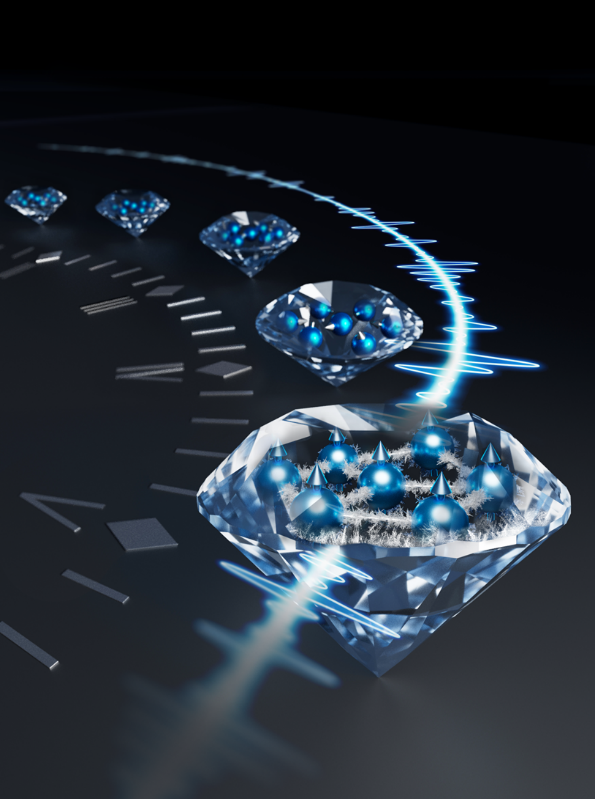
Quantum networks promise transformative applications in secure communication, distributed quantum computing, sensing, and precision timekeeping. Realising real-world metropolitan-scale quantum networks requires compact, deployable systems capable of distributing entanglement over long distances beyond laboratory conditions.
Here, I present a rack-mounted quantum network node based on trapped 40Ca+ ions coupled to a mode of a high-finesse optical cavity, providing an efficient interface between stationary qubits for information processing and travelling photons for information transmission. Developed through a collaboration between the University of Innsbruck and Alpine Quantum Technologies (AQT), the network node enables on-demand generation of single photons polarisation-entangled with a trapped ion. First, I will report on state-of-the-art Bell-state fidelities, efficiencies, and stability achieved with this platform.
Next, using ion–photon entanglement as a resource, we demonstrate remote ion–ion entanglement between this compact network node and a second cavity-coupled 40Ca+ ion in the same laboratory, separated by 50 km of spooled optical fibre. Entanglement was heralded by the coincident detection of two photons,the two-photon detection scheme used here avoids the need for interferometric stabilisation of the kilometre-scale fibre paths. I will present our initial analysis of the Bell-state fidelity, entanglement generation rate, and the dominant limiting factors.